

Researchers at the Institute of Oceanology of the Chinese Academy of Sciences (IOCAS) has made important progress in understanding the climate drivers of recent changes in Antarctic ice-sheet mass.
The research, which was published in Nature on August 19, revealed that sustained warming of the tropical warm pool during 2021–2023 triggered a Rossby wave train propagating toward Antarctica, formed a north–south dipole circulation over East Antarctica, reorganized moisture transport, and enhanced regional snowfall, thereby temporarily slowing Antarctic ice-sheet mass loss.
The Antarctic Ice Sheet is one of the major sources of uncertainty in future global sea-level rise. Over the past two decades, the Antarctic Ice Sheet has generally experienced sustained mass loss at a rate of approximately 140.5 billion tonnes per year. However, its mass increased by about 695 billion tonnes during 2021–2023, marking the largest mass-gain event recorded by the GRACE satellites.
To identify the cause of this event, the research team combined gravity-satellite observations, ice-core snow-accumulation records, and atmospheric circulation model simulations to investigate its atmospheric circulation mechanisms and moisture sources.
The results showed that, during 2021–2023, sustained warming occurred in the tropical warm pool located in the region where the tropical western Pacific and eastern Indian Ocean meet. This warming triggered a Rossby wave train toward high southern latitudes. Eddy–mean flow feedbacks amplified and sustained the resulting circulation, establishing a north–south dipole with low- and high-pressure anomalies south of Australia and along the East Antarctic coast, respectively. The dipole redirected moisture and enhanced atmospheric-river transport from the midlatitude Indian Ocean to East Antarctica.
Water-vapor tracking simulations showed that, under the influence of the dipole circulation, moist air from the midlatitude Indian Ocean was transported to East Antarctica, allowing more atmospheric rivers to reach the region. This resulted in persistent heavy snowfall over the Queen Mary Land–Wilkes Land region and increased ice-sheet mass.
Atmospheric circulation model experiments confirmed that warming of the tropical warm pool was the direct driver of the circulation and snowfall responses. The increase in regional snowfall attributable to anthropogenic forcing was equivalent to only 9% of the observed snowfall anomaly, indicating that atmospheric moistening caused by global warming was not the primary cause of this event. Observations and simulations showed that similar sustained tropical warm-pool warming events occur approximately once every decade. The tropical warm pool therefore acts like a remote "regulator", influencing multiyear variations in snowfall and ice mass over East Antarctica.
However, this temporary slowdown cannot reverse the long-term trend of Antarctic ice-sheet mass loss. The West Antarctic Ice Sheet continues to lose ice, while some outlet glaciers in East Antarctica are also threatened by basal melting of ice shelves and accelerated ice flow caused by warm ocean waters.
This study not only reveals the mechanism by which sustained tropical warm-pool warming drove a rebound in Antarctic ice-sheet mass, but also shows that the north–south dipole circulation over East Antarctica plays a key role in connecting the tropics with ice-sheet mass changes.
"We found a previously underrecognized 'tropical warm pool–East Antarctic Ice Sheet' teleconnection pathway," said WANG Yunhe, first author of the study. "Our research provides a theoretical basis for understanding Antarctic ice-sheet mass changes and conducting future research on the East Antarctic climate."
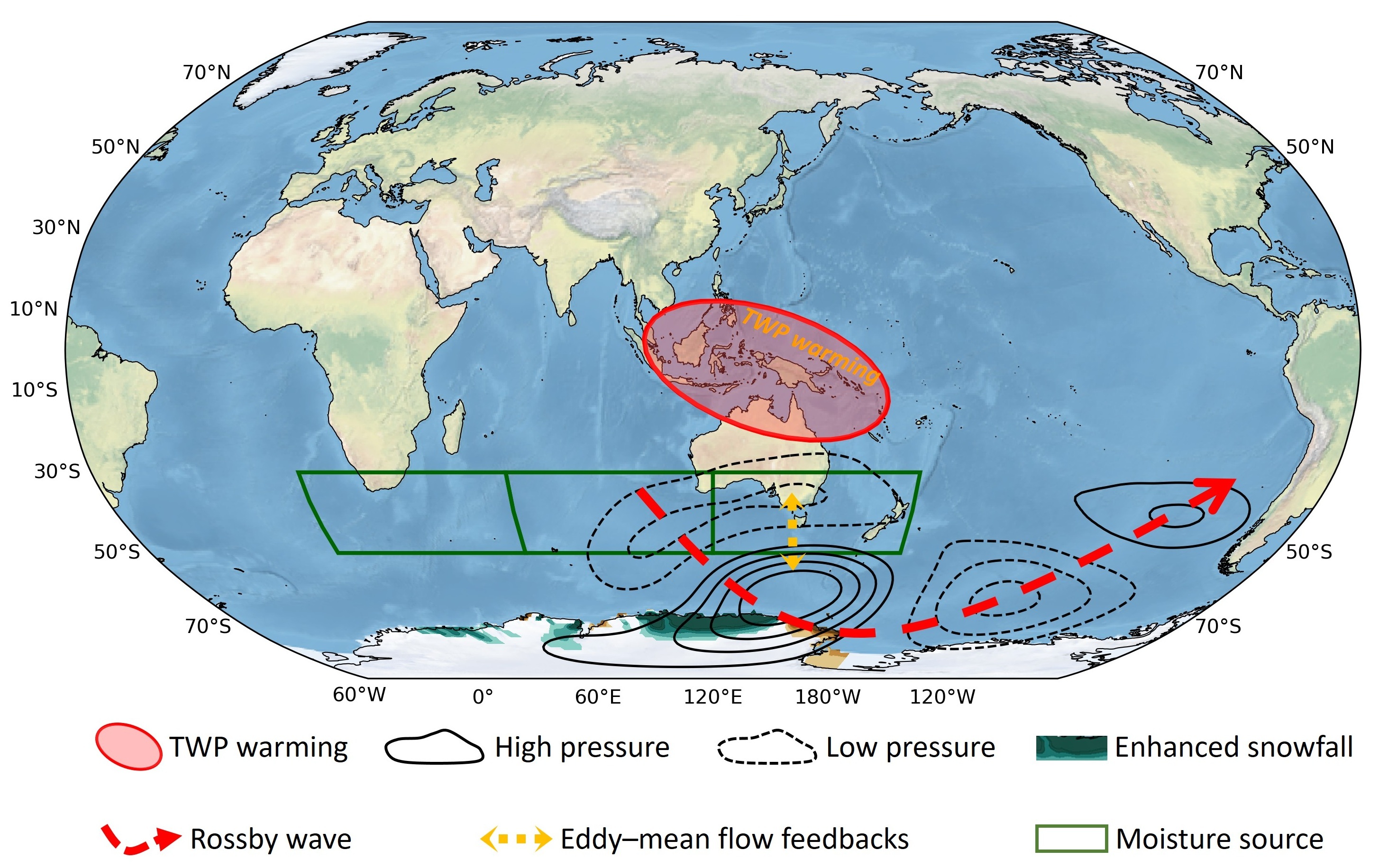
Teleconnection mechanism linking tropical warm-pool warming to temporary Antarctic ice-sheet mass gain. (Image by IOCAS)

Totten Ice Shelf, East Antarctica, photographed in late 2019. (Image by Prof. Yoshihiro Nakayama)
Yunhe Wang, Qinghua Ding*, Xiaofeng Li*, Thomas J. Ballinger, Yoshihiro Nakayama, Dániel Topál, and Eric J. Steig. Multiyear tropical warm pool warming drives slowdown in Antarctic mass loss. Nature, 2026.
(Text by WANG Yunhe)
Media Contact:
ZHANG Yiyi
Institute of Oceanology
E-mail: zhangyiyi@qdio.ac.cn
(Editor: ZHANG Yiyi)