

A research team led by Prof. LI Xiaofeng from the Institute of Oceanology of the Chinese Academy of Sciences (IOCAS) has developed a model to forecast internal solitary waves originating from multiple sources in the Sulu Sea. By combining physical equations with satellite observations, the model predicts wave arrival times and crest positions across this complex marine environment.
The study was published in IEEE Transactions on Geoscience and Remote Sensing on October 19.
Internal solitary waves travel along interfaces between ocean layers of different densities. They can transport energy over long distances, generate strong currents, and enhance ocean mixing. Predicting when and where these waves will arrive is important for understanding ocean dynamics and supporting offshore engineering and navigation.
Forecasting these waves in the Sulu Sea is challenging because they originate in several regions and follow complex paths shaped by islands, straits, and seafloor topography. Forecasts based solely on satellite observations may lack continuity and physical consistency. Meanwhile, traditional empirical models built around a single generation source cannot adequately represent waves originating from multiple regions.
To address these challenges, the researchers combined the Eikonal equation with multiyear satellite imagery and tidal data to identify potential wave generation regions. They then refined a source configuration comprising five point sources and one line source in the southwestern and northeastern Sulu Sea. This configuration better represents the observed propagation characteristics of internal solitary waves.
The forecasting model integrates two complementary components. A physical equation describes the overall wave propagation pattern, while satellite observations provide local corrections to account for differences between modeled and observed waves. Together, these components allow the model to predict wave arrival times and crest positions without requiring a previously observed wave crest as input.
In the independent test set, the full model reduced the propagation-time root-mean-square error by 70.4% compared with the single-source model, from 4.66 to 1.38 hours.
"Representing multiple generation sources was essential to this work, while local corrections based on satellite observations improved the modeled wave propagation patterns," said Dr. LI Zhixin, first author of the study.
This study extends internal solitary wave forecasting beyond the traditional single-source setting to seas with multiple generation regions, the approach could also support forecasts in other complex marginal seas.
"Artificial intelligence is playing an increasingly important role in oceanographic research," said Dr. ZHANG Xudong, the study's corresponding author. "This study offers a practical example of how integrating satellite observations with physical principles can advance ocean forecasting."
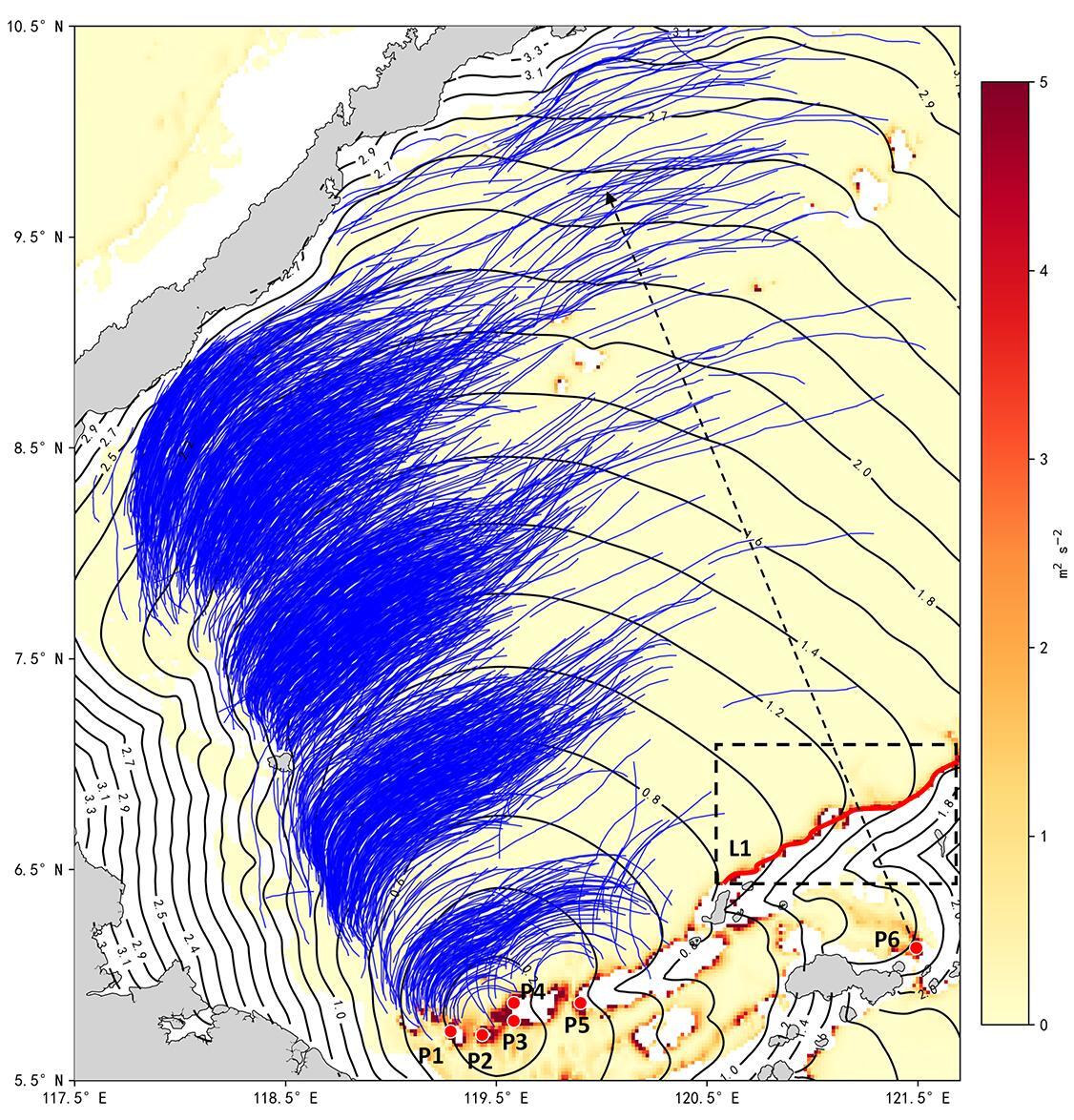
Identification of candidate internal solitary wave generation regions in the Sulu Sea. Blue curves show satellite-observed wave crests, and red markers indicate candidate equivalent sources. (Image by IOCAS)
(Text by ZHANG Xudong)
Media Contact:
ZHANG Yiyi
Institute of Oceanology
E-mail: zhangyiyi@qdio.ac.cn
(Editor: ZHANG Yiyi)