

The modern deep-sea fauna has long been regarded as the product of large-scale ancient colonizations dating from the Middle Paleozoic to the early Cenozoic. However, some evidence suggest that some crab lineages entered deeper waters much later.
Recently, the research team led by Prof. SHA Zhongli from the Institute of Oceanology of the Chinese Academy of Sciences (IOCAS) described a new deep-water species of the family Xanthidae from the South China Sea—Macromedaeus putrimanubriatus. The species occurs at depths of about 100–300 m and differs markedly in morphology from its intertidal congeners. Their findings were published in Zoological Journal of the Linnean Society.
All previously known species of Macromedaeus inhabit nearshore rocky intertidal zones and have broad, flattened carapaces and robust walking legs. In contrast, the new species has a narrower carapace and slender, elongated walking legs. Although its distinctive morphology initially cast doubt on its taxonomic placement, more stable characters such as the male gonopods indicated a close relationship with Macromedaeus. Phylogenetic analyses based on mitochondrial genomes, COI gene sequences, and an amino acid supermatrix of 2,050 single-copy orthologs jointly supported its placement within Macromedaeus and its status as the sister species of the intertidal Macromedaeus orientalis.
Molecular-clock analysis indicates that M. putrimanubriatus and M. orientalis diverged from their common ancestor approximately 13 million years ago, a date closely matching the Middle Miocene Climate Transition (ca. 14.2–13.8 Ma). During this period, the Antarctic ice sheet expanded rapidly, the climate cooled significantly, sea level dropped, and ocean circulation was reorganized. The study suggests that changes in shallow-water environments and in food supply, or the availability of vacant deep-water niches, may have driven its ancestor out of the intertidal zone into deeper water.
The researchers further compared deep-water and shallow-water species across other groups of Xanthoidea and found a similar trend: deep-water species tend to have narrower, smaller carapaces and more slender, flattened walking legs. These shared features are interpreted as convergent adaptations to soft deep-water bottoms, dispersed food resources, and lower predation pressure. A relatively lightweight body and slender, flattened legs help elevate the body, facilitate slow movement over sediment, and reduce maintenance costs. This pattern illustrates convergent evolution—the independent evolution of similar morphological or functional traits in different lineages under similar selective pressures.
This relatively young colonization event indicates that the modern deep-water fauna consists of both ancient and younger lineages. "We named the new species after the Chinese legend of 'Wang Zhi and the Rotten Axe Handle' to highlight how rapidly morphology can diverge under the selective pressures of the deep-water environment," said Dr. YUAN Ziming, the first author of the study.
The study shows that deep-water environments significantly shape morphology and provides important scientific evidence for understanding the formation and evolutionary history of deep-sea fauna.
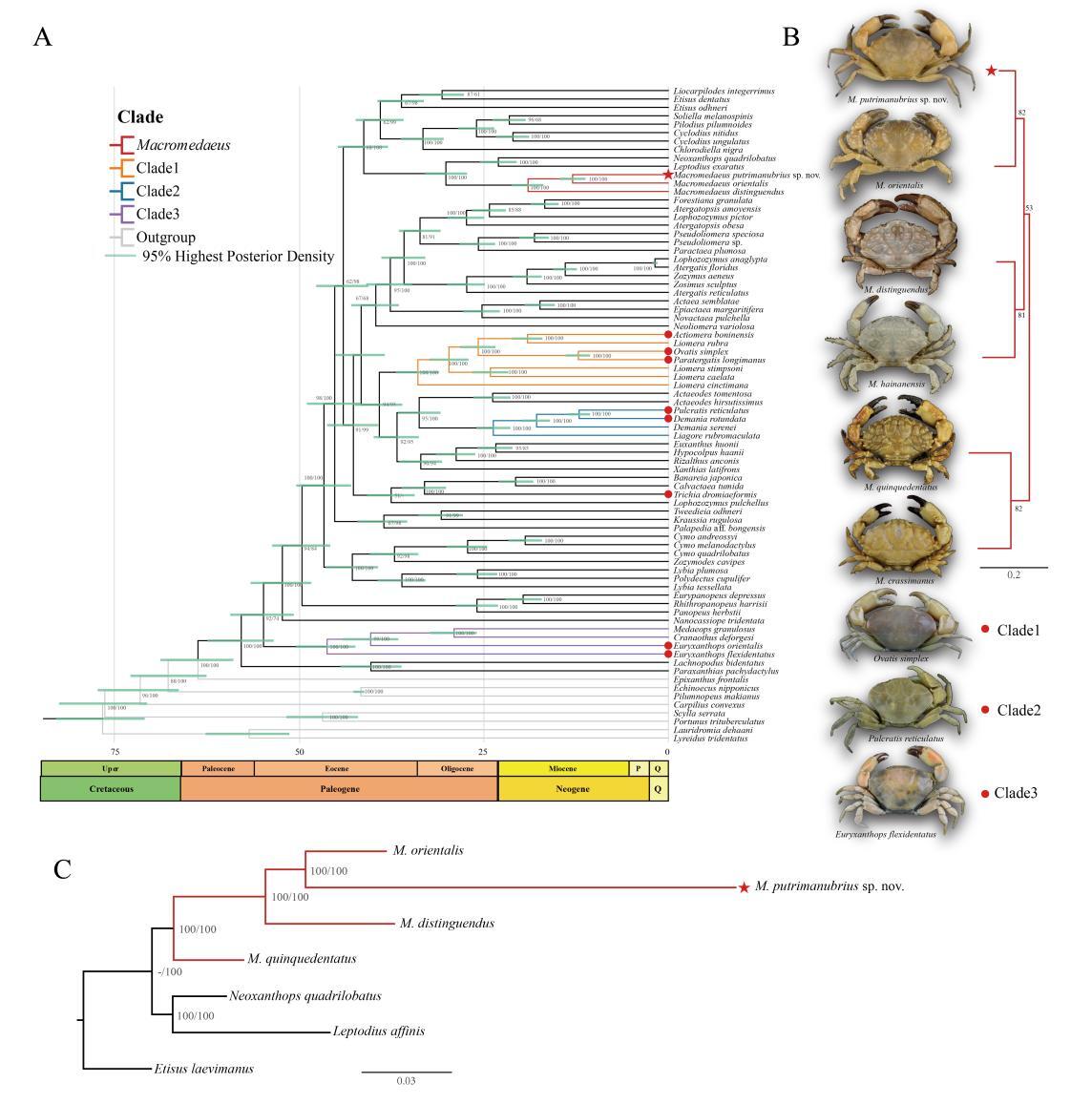
Phylogenetic relationships of Xanthoidea and the genus Macromedaeus reconstructed using multiple methods, showing the phylogenetic position of the new species Macromedaeus putrimanubriatus. (Image by IOCAS)
(Text by YUAN Ziming)
Media Contact:
ZHANG Yiyi
Institute of Oceanology
E-mail: zhangyiyi@qdio.ac.cn
(Editor: ZHANG Yiyi)