

Kelp species like Saccharina japonica and Undaria pinnatifida are vital global economic resources. However, global warming, increasing seawater temperatures, is severely impacting kelp cultivation. This makes breeding new, heat-resistant kelp cultivars with wider adaptability an urgent priority to counter climate threats. While triploid breeding is common in terrestrial crops, it's rarely used for seaweeds.
To address this challenge, a research team led by Prof. SHAN Tifeng from the Institute of Oceanology of the Chinese Academy of Sciences (IOCAS) has developed a novel method to breed triploid cultivars in kelp species.
The study was published in Journal of Phycology on Nov. 15.
Previous studies obtained diploid gametophytes from heterozygous sporophytes through apospory, but their sex was variable and unpredictable, which makes it difficult to conduct precise cross to breed triploid lines. "This issue has become the main technical bottleneck restricting triploid breeding in kelp," said Prof. SHAN, corresponding author of the study.
Based on the doubled haploid (DH) population construction technology and using Undaria pinnatifida as a target species, the researchers proposed a new method to generate homozygous diploid gametophytes by inducing apospory of DH sporophytes, and then crossed them with haploid gametophytes to obtain triploid sporophytes, which addresses the technical bottleneck mentioned above.
They obtained DH sporophytes through selfing of a monoicous gametophyte, and then successfully obtained a single-sex (male) diploid gametophyte through apospory. Male diploid gametophytes were crossed with 3 female haploid gametophyte clonal lines, and 3 triploid hybrid lines were successfully obtained.
The results of cultivation on a seaweed farm showed that compared with ordinary diploid cultivars, triploid hybrids had superior characteristics such as faster growth rate, longer blades, better resistance to high temperature and aging, and had significant characteristics of sterility.
"The triploid breeding method established in this study may also be applicable to other kelp species because they have a similar life history," added Prof. SHAN.
This study are of great significance for establishing a key technical system of polyploid breeding in economically important kelp species, obtaining high-quality, stress-resistant and widely adaptable polyploid cultivars, and facilitating the stability, health and sustainable development of the huge seaweed cultivation industry.
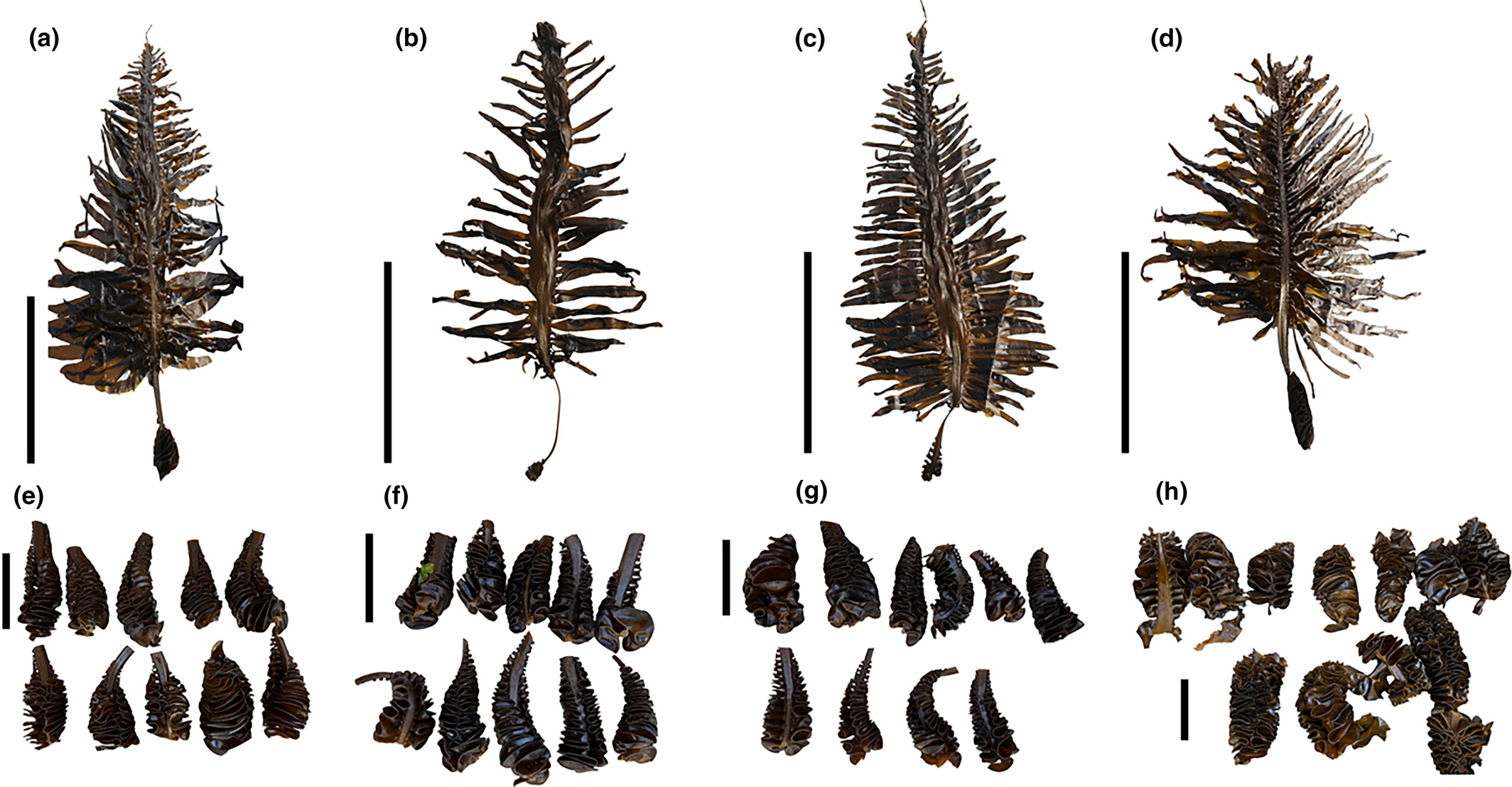
Triploid sporophytes of Undaria pinnatifida (a,b,c) and their sporophylls (e,f,g) and their diploid counterparts (d, h). (Image by IOCAS)
(Text by SHAN TiFeng)
Media Contact:
ZHANG Yiyi
Institute of Oceanology
E-mail: zhangyiyi@qdio.ac.cn
(Editor: ZHANG Yiyi)