

A research team led by Dr. BI Haibo from the Institute of Oceanology of the Chinese Academy of Sciences (IOCAS), has revealed that accelerated warming in the North Pacific has contributed to a significant slowdown in Arctic summer sea ice loss since 2007. Their findings were published in Communications Earth & Environment.
While global mean surface temperatures have surged—breaching the 1.5°C Paris Agreement threshold in 2024—the September minimum Arctic sea ice extent has not set a new record low since 2012. Between 2007 and 2024, the trend in September sea ice area was nearly zero, a stark contrast to the steep decline observed from 1979 to 2006.
Using a combination of observational data and numerical modeling, the researchers identified a key player: the North Pacific Ocean. A pronounced warming trend in North Pacific sea surface temperatures (SSTs) has triggered an atmospheric Rossby wavetrain—a large-scale pattern of atmospheric waves—that propagates into the Arctic.
This wavetream induces a negative phase of the summertime Arctic Dipole (AD), a climate pattern characterized by specific pressure distributions over the Arctic. The resulting atmospheric circulation brings cooler air, reduces downward longwave radiation, and alters surface wind patterns. These changes have enhanced sea ice concentration in two key regions: the central Arctic Ocean near 180°W and the Canadian Arctic Archipelago, with annual increases of 0.4% and 1.1%, respectively.
Although some areas, such as the Greenland Sea and northern Laptev Sea, continue to experience sea ice decline, the gains in the central Arctic and Canadian Archipelago have partially offset these losses. This regional variability explains the overall slowdown in the Arctic's sea ice retreat.
The researchers further used climate model simulations to isolate the influence of North Pacific SST anomalies. The results confirmed that Pacific warming alone can generate the same atmospheric wave patterns observed in the Arctic, leading to localized cooling and sea ice growth.
Dr. BI noted, "This slowdown is likely a temporary phenomenon, driven by natural climate variability interacting with human-induced warming." The North Pacific warming itself is largely attributed to greenhouse gas emissions, highlighting the complex interplay between anthropogenic forcing and natural cycles.
Current climate models, including those from CMIP5 and CMIP6, struggle to reproduce the observed summer teleconnections between the Pacific and the Arctic, suggesting a need for model improvement to better predict near-term sea ice behavior.
"Understanding these processes is crucial for refining future projections of Arctic sea ice," added Dr. BI. "While the long-term decline is expected to continue, episodes of stabilization remind us that natural variability can modulate—but not halt—the effects of climate change."
The study underscores the importance of incorporating oceanic teleconnections into climate models to improve predictions of Arctic sea ice loss, which has profound implications for global weather patterns, ecosystems, and coastal communities.
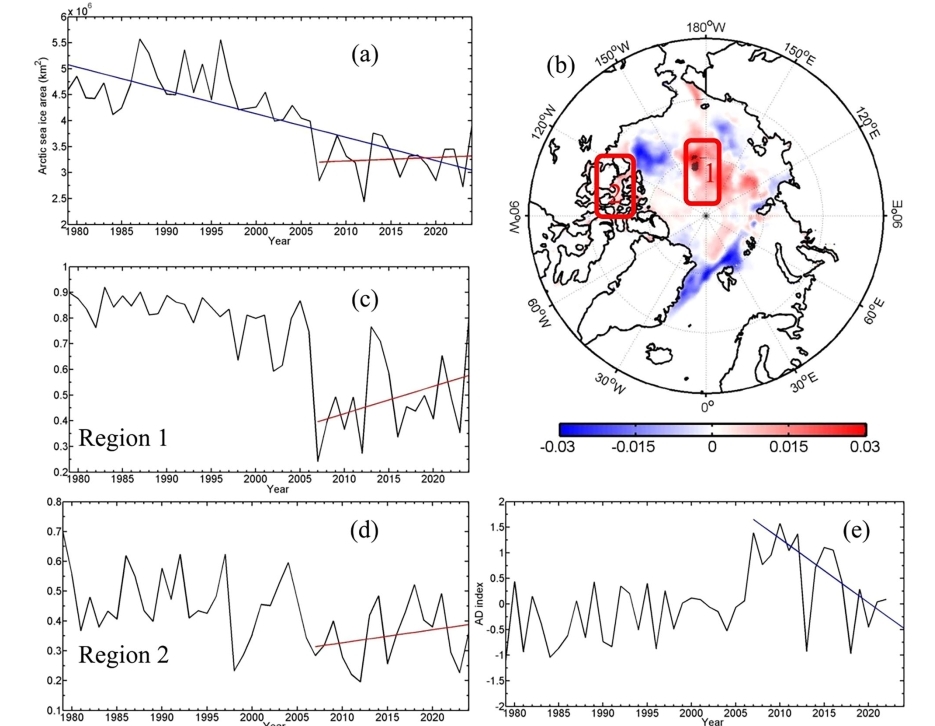
Slowing down of Arctic sea ice loss. (Image by IOCAS)
(Text by BI Haibo)
Media Contact:
ZHANG Yiyi
Institute of Oceanology
E-mail: zhangyiyi@qdio.ac.cn
(Editor: ZHANG Yiyi)