

Deep-sea cold seeps are key channels for seafloor methane, but quantifying their emissions has been challenging, creating uncertainties in the global ocean methane budget. To fill this knowledge gap, a research team from the Institute of Oceanology of the Chinese Academy of Sciences (IOCAS) has found that methane emissions from South China Sea cold seeps far exceed previous estimates, providing important scientific evidence for the accounting of oceanic greenhouse gas sources and sinks.
The study was published in The Innovation Geoscience.
The researchers focused on Site F, an active cold seep area on the northern continental slope of the South China Sea. They combined deep-sea in-situ detection technologies with geochemical steady-state models to quantitatively characterize the migration and transformation process of methane from the seafloor to the water column in cold seeps. "The technical breakthrough of this work lies in the integration of multi-parameter collaborative detection equipment and fine-scale in-situ environmental detection on the seafloor," said Dr. CAO Lei, first author of the study.
The research team used a multi-parameter sensing system integrated with methane sensors, dissolved oxygen sensors, etc., along with synchronous precision sampling equipment, to conduct fine-scale detection of the near-bottom seawater environmental field in different habitats of the active cold seep area through the remotely operated vehicle (ROV) "Discovery" carried by the research vessel "Kexue" during three cruises in 2017, 2018, and 2020, achieving continuous, high-resolution observations of key environmental parameters such as methane and dissolved oxygen.
Based on in situ observation data, the researchers established a steady-state box model to quantify the migration and transformation pathways of methane in the cold seep area. The results showed that the methane flux in the active seepage area was three orders of magnitude higher than the diffusive flux across the cold seep sediment-water interface. This significant difference reveals that previous studies have severely underestimated the emission intensity of methane from cold seeps. Meanwhile, the model results indicate that the migration and removal of methane in the South China Sea seafloor cold seeps are mainly controlled by horizontal advection.
Accordingly, the annual methane emissions from the South China Sea cold seep area were estimated to be 0.70–4.22 Gmol. If this result is extrapolated to active cold seeps on global continental slopes, the amount of methane entering the hydrosphere in dissolved form each year is equivalent to 126 Tg of carbon. This value is twice the estimated methane emissions from shallow continental shelves and significantly higher than previous estimates of global mud volcano methane release, highlighting the long-overlooked important role of deep-sea cold seeps in the global methane cycle.
These findings not only revolutionize the understanding of deep-sea methane cycle mechanisms but also provide key data support for the assessment of the global methane budget.
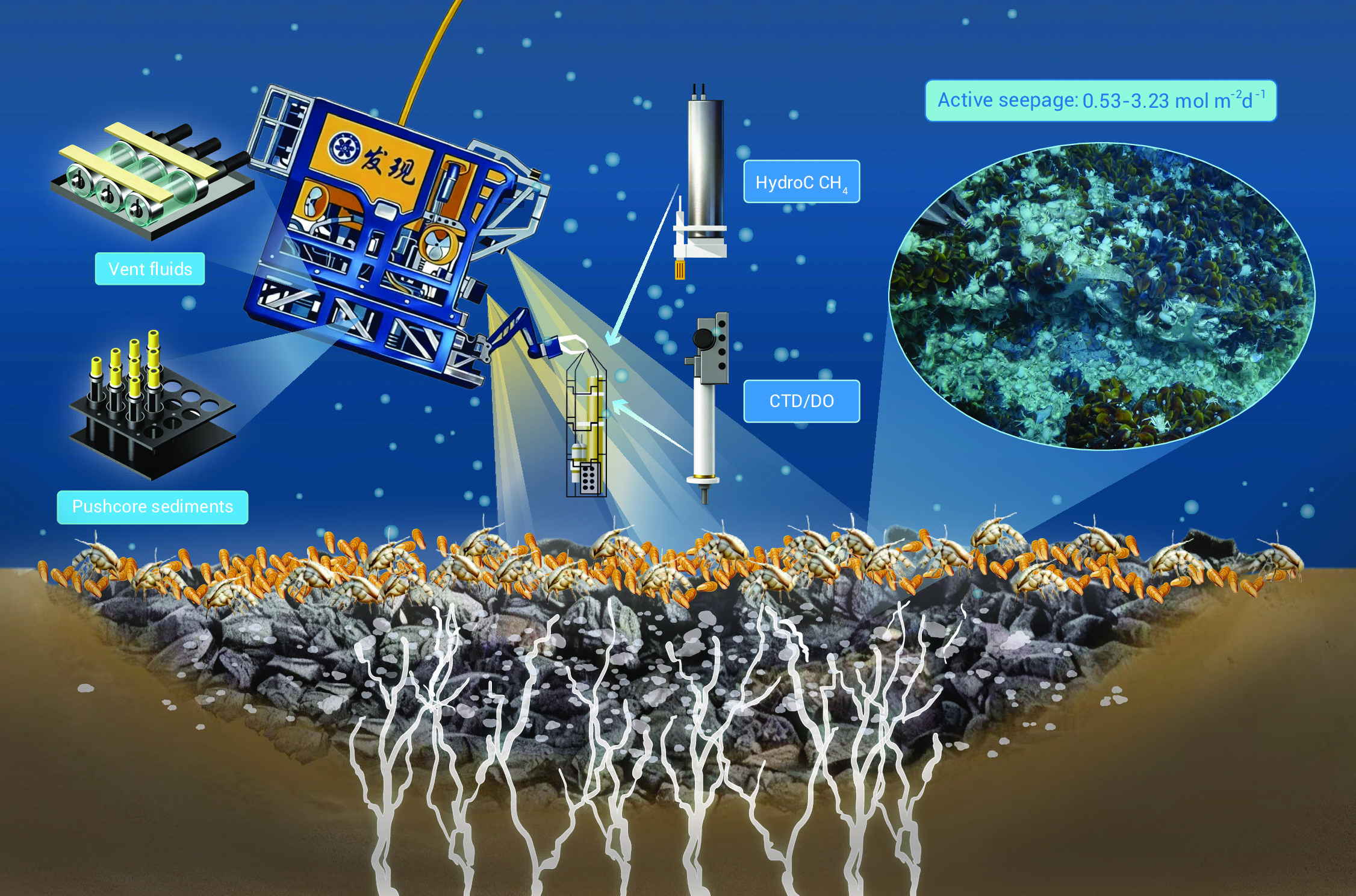
In situ detection of methane fluxes from active cold seep in the South China Sea. (Image by IOCAS)
(Text by CAO Lei)
Media contact:
ZHANG Yiyi
Institute of Oceanology
E-mail: zhangyiyi@qdio.ac.cn
(Editor: ZHANG Yiyi)