

The El Niño–Southern Oscillation (ENSO) is one of the most influential climate phenomena on Earth, shaping weather patterns worldwide and driving extreme events. For decades, scientists have relied primarily on sea surface temperature to predict ENSO. However, the accuracy of ENSO forecasts has declined since the early 2000s.
To address this issue, a research team led by Prof. LI Xiaofeng from the Institute of Oceanology of the Chinese Academy of Sciences (IOCAS) investigated the role of ocean salinity using observational data and an interpretable artificial intelligence framework (STPNet). Their results point to an important missing piece: sea surface salinity (SSS), —a factor that has long been overlooked but is now proving critical under a changing climate.
The study was published in Geophysical Research Letters on April 8.
The researchers highlight a pronounced decline in the performance of temperature-based forecasts at longer lead times after 2014. In contrast, predictions that incorporate salinity maintain strong skill even beyond 20 months, indicating a growing role for salinity under changing climate conditions.
They found that this shift is closely linked to the Indonesian Throughflow (ITF), a system of ocean currents connecting the Pacific and Indian Oceans. Acting as a key pathway for the exchange of heat and freshwater, the ITF plays a central role in regulating the background state of the tropical oceans. In recent decades, temperature-driven transport through the ITF has weakened, while salinity-driven changes have strengthened, helping to sustain inter-basin exchange and preserve subsurface ocean memory essential for ENSO development.
"The ITF has transitioned from a passive conduit to an active modulator of ENSO evolution," said Prof. WANG Jing, first author of the study. Incorporating salinity into prediction systems can significantly improve forecast skill, especially at longer lead times.
This study also demonstrates how explainable AI can reveal physical processes that are not easily captured by traditional approaches, allowing the researchers to identify a salinity-mediated pathway that has become increasingly important in today's climate.
The study suggest that the role of salinity in ENSO predictability has strengthened markedly in the post-hiatus period, reflecting broader changes in ocean conditions under global warming. As the climate system continues to evolve, incorporating salinity into prediction models may be essential for maintaining reliable long-term forecasts. This improvement could enhance the ability to anticipate extreme climate events and better understand how the climate system is responding to global warming.
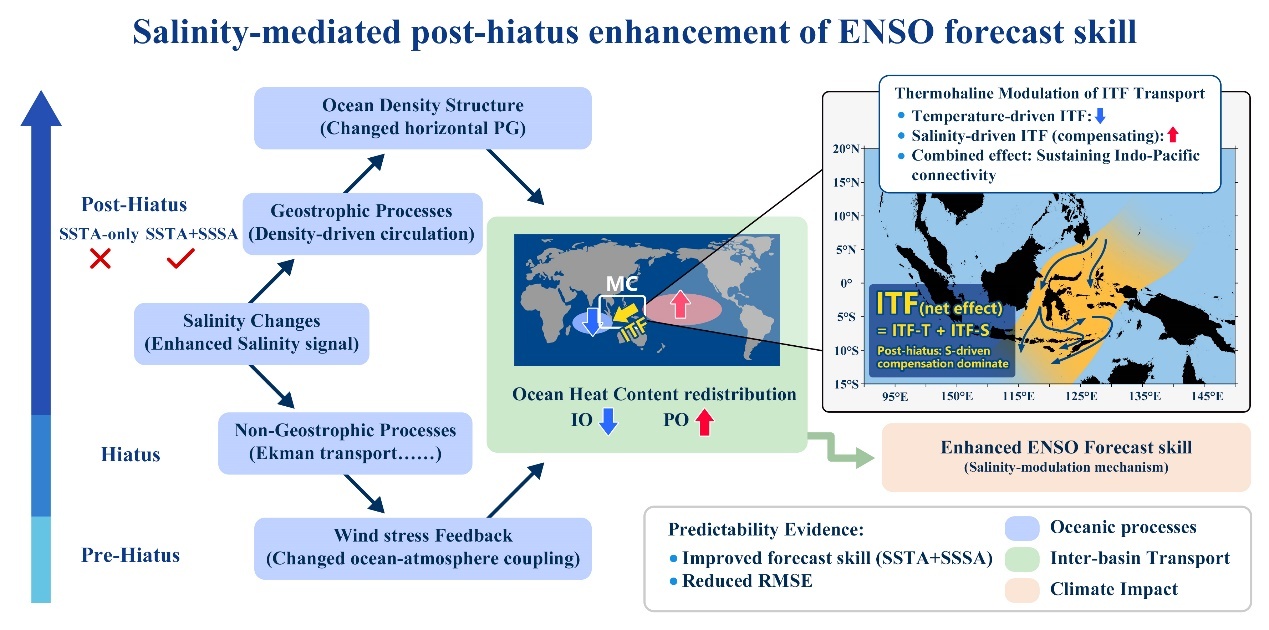
Conceptual schematic of salinity-mediated enhancement of ENSO forecast skill. (Image by IOCAS)
(Text by WANG Jing)
Media Contact:
ZHANG Yiyi
Institute of Oceanology
E-mail: zhangyiyi@qdio.ac.cn
(Editor: ZHANG Yiyi)