

In deep-sea ecosystems, methanogenic archaea are key drivers of the global methane cycle, particularly in methane-rich cold seep environments. Phosphorus, an essential element for life, is typically utilized by microorganisms as inorganic phosphate. In the deep ocean, inorganic phosphorus is extremely scarce, while organic phosphorus is abundant in sediments. However, how methanogenic archaea maintain growth and metabolism under phosphorus-limited conditions has long remained unclear.
To answer this question, a research team led by Prof. SUN Chaomin from the Institute of Oceanology of the Chinese Academy of Sciences (IOCAS) has revealed that deep-sea methanogenic archaea efficiently utilize phosphorus and store energy through polyphosphate (polyP) metabolism. Their findings were published in PNAS.
The researchers isolated eight methanogen strains from cold seeps and seamounts in the South China Sea. They identified polyphosphate granules within these strains and demonstrated that the Polyphosphate kinase 1 (PPK1) is responsible for polyphosphate synthesis. Knockout of the ppk1 gene led to a significant reduction in both growth rate and methane production.
"Polyphosphate is not just a phosphorus reservoir — it serves as a critical hub linking environmental phosphorus supply to core cellular metabolism," said ZHENG Rikuan, the first author of the study.
They also found that under inorganic phosphorus deficiency, the strains can utilize organic phosphorus sources such as starch and chitosan, and release bioavailable inorganic phosphorus by upregulating two phosphoesterases (V7059_S02375 and V7059_SS09360), which can then be synthesized into polyphosphates through PPK1 to support growth and methanogenesis. In situ experiments in the South China Sea cold seeps confirmed the environmental relevance of this metabolic strategy.
Transcriptome analysis showed that this process was accompanied by significant upregulation of the phosphate specific transport system (Pst system) and ppk1, while ppk2 was inhibited.
This study challenges the traditional view that deep-sea microorganisms passively adapt to phosphorus limitation. Instead, methanogens actively regulate phosphorus acquisition, storage, and utilization through an elegant polyP metabolic system.
"Our study provides new molecular evidence for understanding the coupling between carbon and phosphorus cycles in deep-sea cold seep ecosystems," added Prof. SUN.
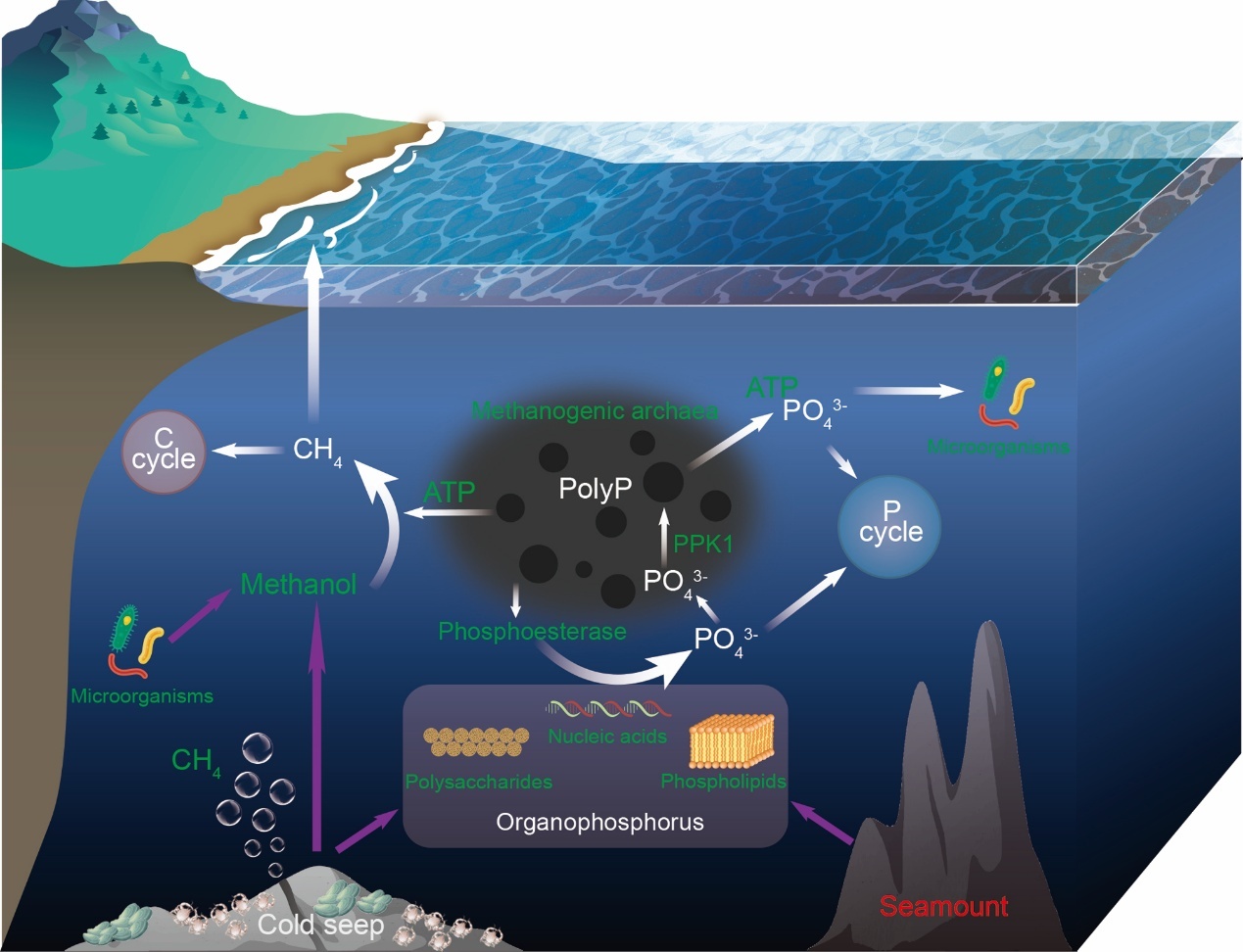
Schematic diagram showing the coupling of carbon and phosphorus cycling driven by deep-sea methanogenic archaea. (Image by ZHENG Rikuan, IOCAS)
(Text by ZHENG Rikuan)
Media Contact:
ZHANG Yiyi
Institute of Oceanology
E-mail: zhangyiyi@qdio.ac.cn
(Editor: ZHANG Yiyi)