

Subduction zones are among the most important sites for material circulation between Earth's surface and interior. Arc rupture and back arc expansion reflect the complex interactions between deep processes and surface structures on Earth, playing an important role in understanding the formation of oceanic crust, material cycling, and the habitability of the Earth.
However, due to the lack of robust tomographic constraints, the role of deep mantle upwelling in arc rifting and back-arc spreading in subduction zones has remained unclear.
To address this issue, the research team from the Institute of Oceanology of the Chinese Academy of Sciences (IOCAS) has made a three-dimensional (3-D) P-wave tomographic study of the Izu-Bonin-Mariana (IBM) subduction zone. By integrating seismic data recorded at both land-based seismic stations and ocean bottom seismometers, they imaged the 3-D P-wave velocity structure at depths of 20 to 700 km. Their finding were published in Journal of Geophysical Research: Solid Earth on Aug. 10.
They found distinct low-velocity anomalies beneath the Izu-Bonin and Mariana subduction zones, which may indicate deep mantle upwelling caused by processes such as dehydration of the deeply subducted slab, melting of oceanic crust, and the migration of volatiles. Beneath Izu-Bonin, the upwelling appears to rise obliquely from the base of the upper mantle (at ~400 km depth) and tilt away from the Izu-Bonin arc, suggesting that it does not directly affect the arc region.
In contrast, beneath Mariana, the upwelling rises nearly vertically from the mantle transition zone (at ~550 km depth) to the Mariana Trough, providing materials and dynamic support for the arc rifting and back-arc spreading there. These contrasting upwelling patterns may be an important reason for the different evolutionary stages of arc rifting and back-arc spreading in the two regions.
The results further suggest that, similar to continental rifting and formation of new oceanic crust, deep mantle upwelling and its associated material circulation may be important dynamic factors driving arc rifting and back-arc spreading in subduction zones, in addition to shallow tectonic stresses.
"Our study provides new seismic evidence that deep mantle processes are closely linked to surface tectonic evolution in subduction zones," said Prof. FAN Jianke, the study's corresponding author. "This helps us better understand how material circulation within Earth's interior contributes to the formation of oceanic crust and the evolution of subduction systems."
The study provides new insight into the dynamic coupling between deep mantle processes and shallow tectonic deformation in the IBM subduction zone, and highlights the important role of deep mantle upwelling in driving Earth's internal and surface evolutions.
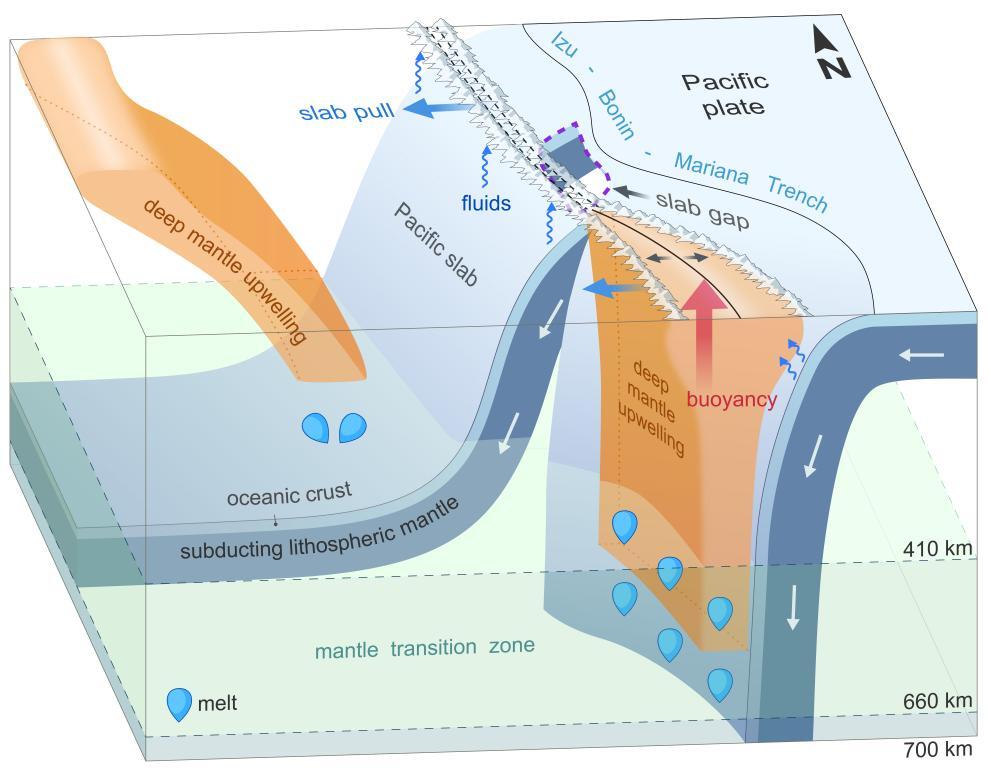
A schematic diagram of deep mantle upwelling, material circulation, arc rifting, and back-arc spreading in the IBM region. (Image by IOCAS)
(Text by SHE Lijuan)
Media Contact:
ZHANG Yiyi
Institute of Oceanology
E-mial: zhangyiyi@qdio.ac.cn
(Editor: ZHANG Yiyi)