

Marine equipment faces persistent risks from coating damage and metal corrosion, while monitoring and protection systems require reliable power supplies and regular maintenance. Harnessing wave energy offers a renewable energy source, but integrating power generation, corrosion protection, and environmental sensing within a single physical architecture remains challenging.
To address this challenge, researchers from the Institute of Oceanology of the Chinese Academy of Sciences (IOCAS) drew inspiration from active electrolocation in weakly electric fish and cooperative sensing in fish schools to develop a wave-driven tubular platform based on dynamic multi-interface electrical double layers. The platform couples energy harvesting with environmental perception, enabling coating monitoring, self-powered cathodic protection, wave-state recognition, and two-dimensional spatial decoding.
Electrical double layers (EDLs) at solid–liquid interfaces mediate charge separation and ion transport. The researchers developed an acrylic through-tube architecture that connects the inner and outer aqueous pathways, coupling an outer fluorinated ethylene propylene–water (FEP–water) interface with an inner polymethyl methacrylate–water (PMMA–water) interface.
Wave-induced water motion periodically assembles and disassembles the EDLs at both interfaces. The inner liquid functions as a dynamic charge reservoir, enabling charge redistribution between the coupled interfaces. This process initiates charge relay and parallel release, enhancing charge transfer and short-circuit current.
Control experiments using matched geometries, an equal-area single-interface configuration, and an inactive inner-wall interface showed that the enhanced output primarily arose from liquid-connectivity-enabled dynamic coupling. These results establish the role of coordinated charge release between the inner and outer interfaces in improving wave energy harvesting.
The researchers connected multiple devices in parallel to achieve power addition and regulated output. The regulated output was further used for self-powered cathodic protection. The platform also supports in situ coating monitoring and early warning. An intact insulating coating maintains an open circuit with a near-zero current response. When local damage exposes the conductive substrate, an ion–electron coupled dynamic EDL is established, generating a distinct warning current under wave excitation. This allows coating damage to be detected through the electrical response of the interface itself.
For environmental sensing, the researchers drew inspiration from the contrast-coding strategy of weakly electric fish, in which signal polarity and amplitude convey information about the surrounding environment. Wave-induced charge redistribution within the dynamic EDLs produces current signatures whose amplitudes and temporal variations enable wave-state recognition.
Meanwhile, inspired by cooperative sensing in fish schools, the team constructed a main–auxiliary electrode network comprising a near-end main electrode and auxiliary electrodes distributed across four directional regions. The network organizes local EDL responses from different positions into a coordinated spatial pattern that can be jointly decoded. Cooperative responses and signal comparisons enhance directional contrast and far-end sensing, enabling two-dimensional spatial decoding.
"Our study connects multi-interface charge relay, array-based energy harvesting, and bio-inspired spatial sensing within a dynamic EDL platform," said NAN Youbo, first author of the study. The ion motion responsible for power generation also encodes hydrodynamic and spatial perturbations as electrical signals, allowing energy harvesting, corrosion protection, and environmental perception to share the same physical process.
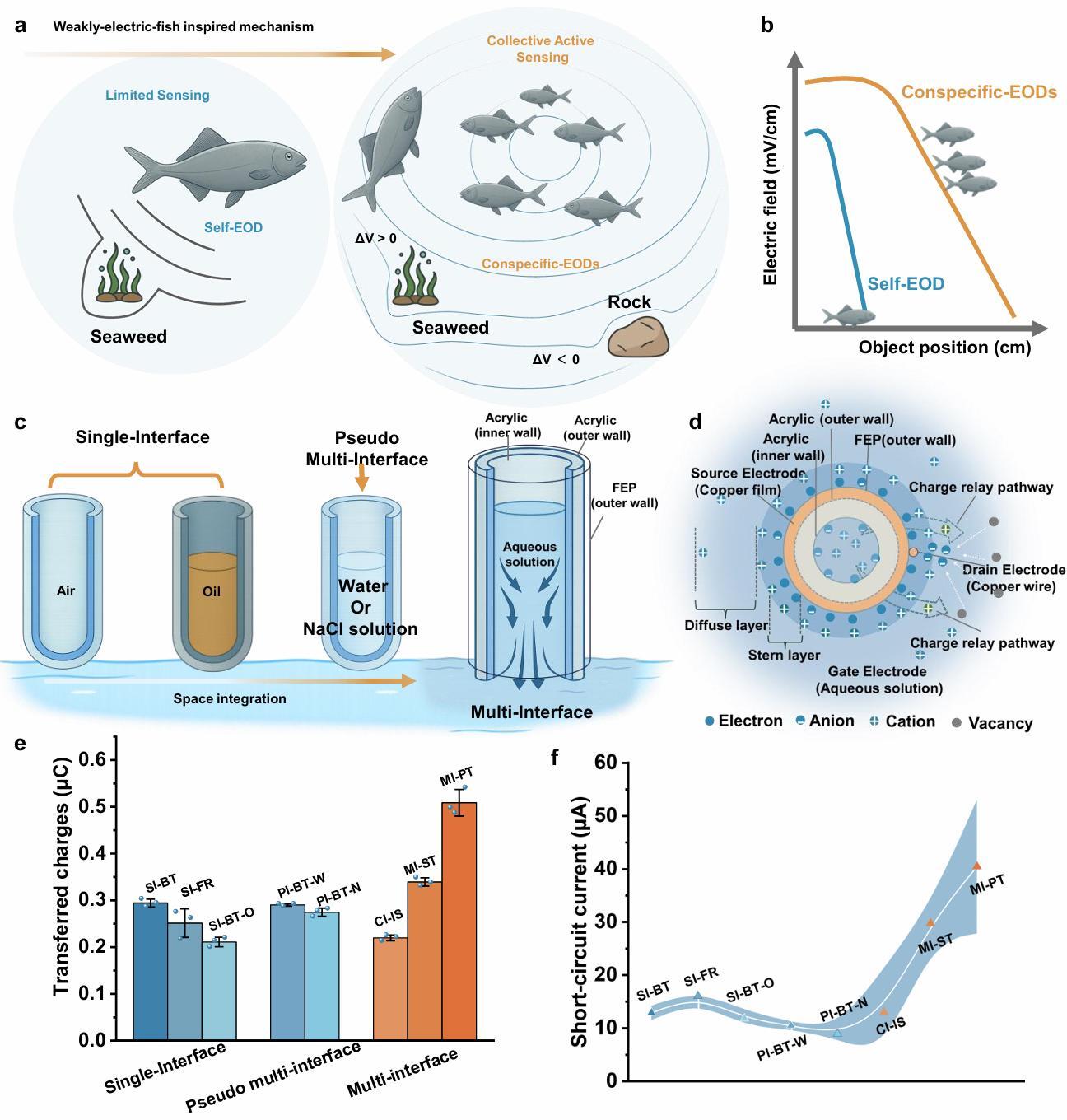
Multi-interface electrical double layer charge-relay architecture and performance validation. (Image by IOCAS)
(Text by NAN Youbo)
Media Contact:
ZHANG Yiyi
Institute of Oceanology
E-mail: zhangyiyi@qdio.ac.cn
(Editor: ZHANG Yiyi)