

Genome-editing-based breeding has advanced rapidly in aquaculture, but the progress in marine mollusks have lagged behind. The main challenge lies not in genome editing itself but in rearing the few edited larvae to go through metamorphosis to establish a viable G0 founder population.
To address this issue, the research team from the Institute of Oceanology of the Chinese Academy of Sciences (IOCAS) worked through a series of technical hurdles, mainly including the difficulty of culturing genome-edited larvae and low metamorphosis rates. They successfully produced a G0 genome-edited population of about 100 juveniles in the Pacific abalone (Haliotis discus hannai). The largest individuals reached about 3 cm in shell length. Their findings were published in Aquaculture.
The researchers targeted a tyrosinase gene (Hdh-tyr1) related to shell formation and obtained genome-edited larvae carrying mutations. Rearing these larvae, however, was proved to be the most difficult part of the work. Due to limitations in culture techniques, in the early stages of our experiments, all batches of genome-edited larvae died completely.
In conventional small-volume culture systems, protist always outbreaks and wiped out entire larval batches within days. After repeated optimization, the researchers reared each larva separately in a single well, which they described as "single apartments". They combined this with an optimized metamorphosis induction protocol, which ensured larval survival rates of higher than 90%.
At the juvenile stage, the researchers isolated three benthic diatom species as high-quality feed for newly metamorphosized abalones, which supported rapid growth. They also developed a simplified DNA extraction method that allowed efficient genotyping of very small juveniles individually.
"The individual-level check provided an early 'identity verification' of the edited animals," said YU Yanan, the first author of the study. "It also helped confirm that mutated larvae had developed into mutated juveniles."
The resulting workflow covers editing-system construction, larval and juvenile rearing, metamorphosis induction, and genotyping of single individuals. "Using this workflow, we generated the G0 genome-edited population," said Prof. HUAN Pin, one of the corresponding authors of the study. This work represents a key step toward completing the technical chain for genome-editing-based breeding in mollusks.
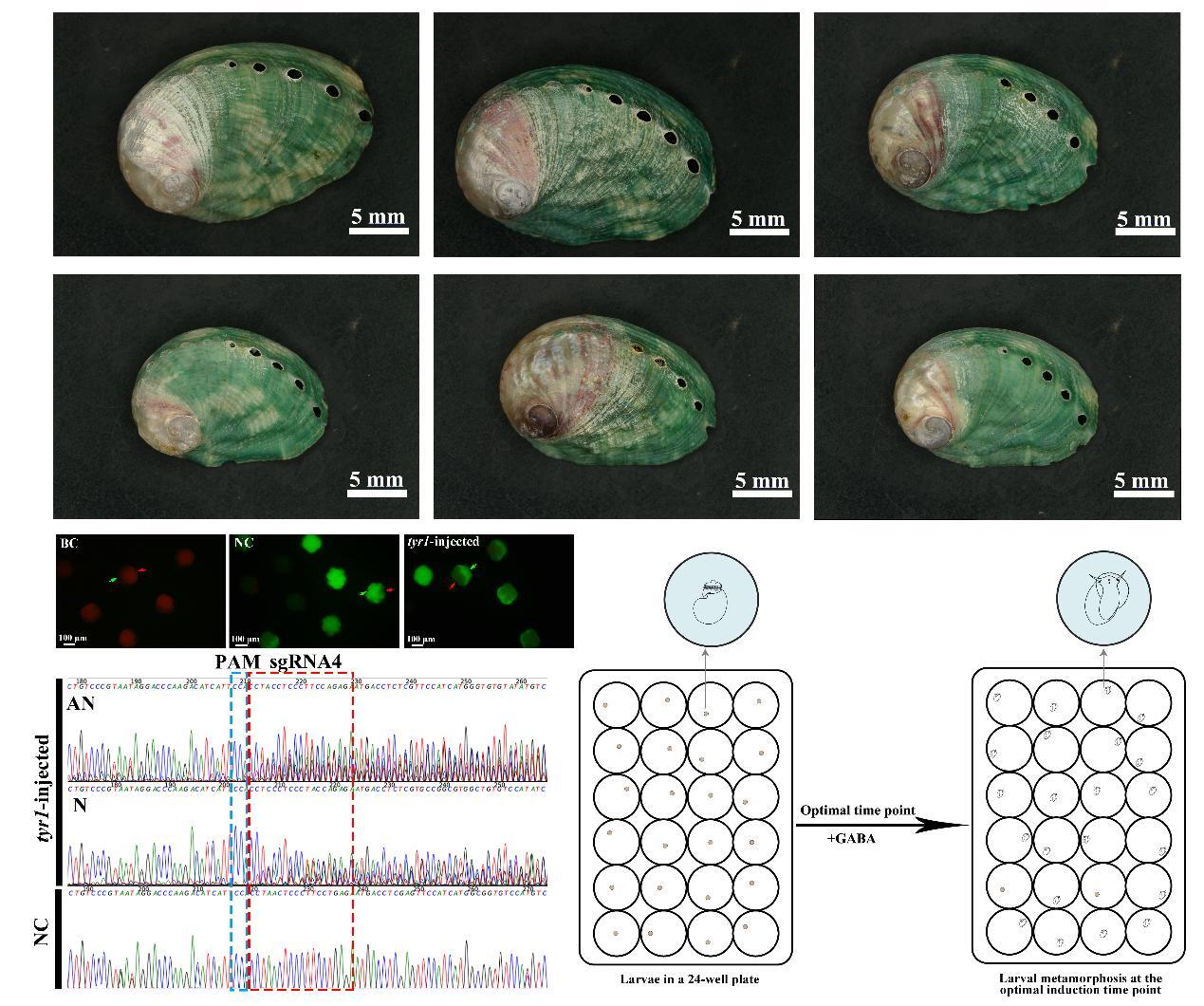
G0 genome-edited Pacific abalone individuals and the main technical workflow. (Image by IOCAS)
(Text by YU Yanan)
Media Contact:
ZHANG Yiyi
Institute of Oceanology
E-mail: zhangyiyi@qdio.ac.cn
(Editor: ZHANG Yiyi)