

(Text by REN Yibin, yibinren@qdio.ac.cn)
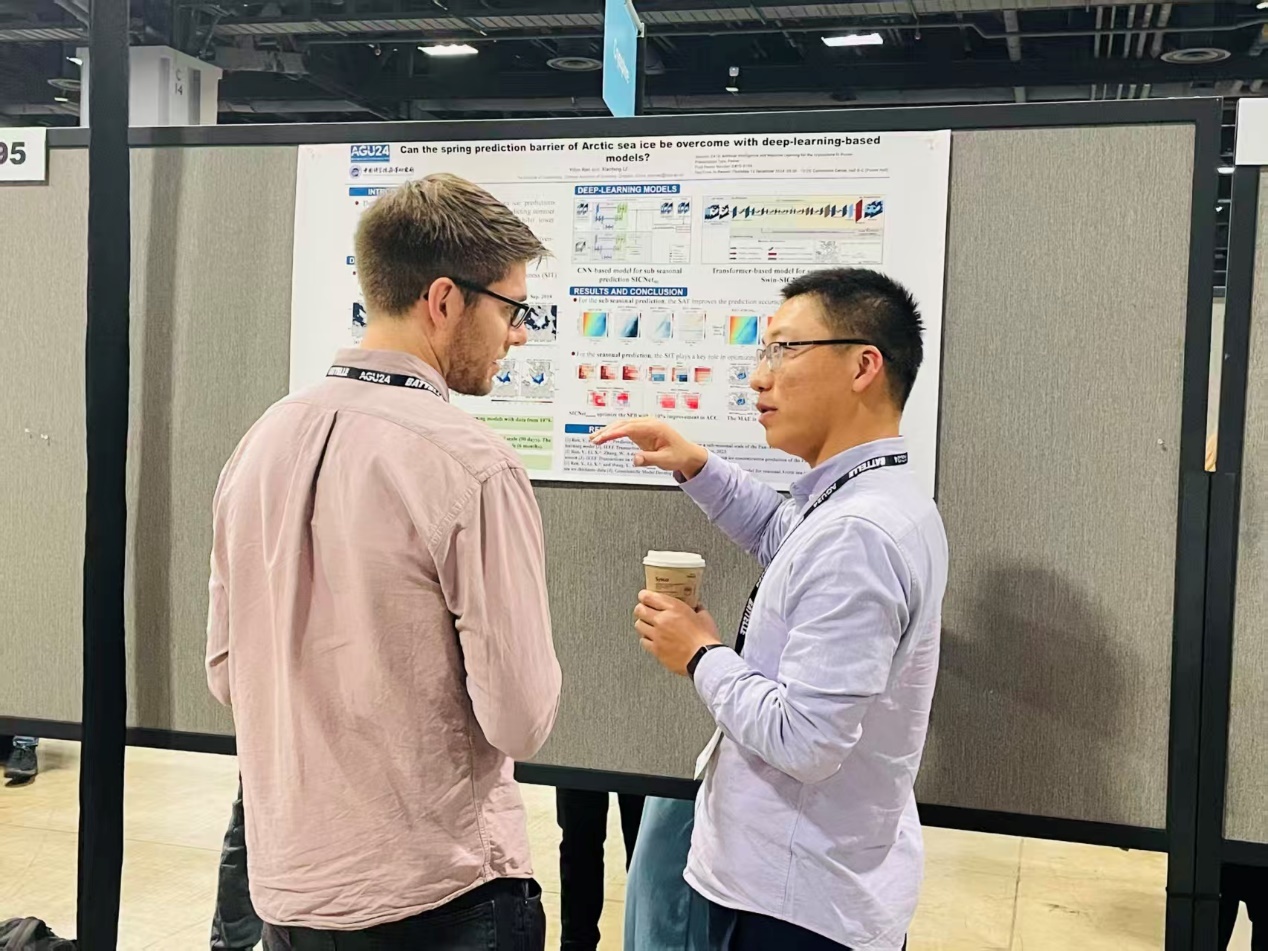
Yibin was introducing the AI-based sea ice prediction model to international colleagues from the NOAA at the AGU 2024. Credit: Institute of Oceanology, Chinese Academy of Sciences
I am a researcher working in AI for ocean science, with a particular focus on remote sensing for monitoring and intelligent prediction of Arctic sea ice. Although sea ice may seem far away from our daily lives, it plays a vital role in the global climate system, polar ecosystems, and our understanding of environmental change on Earth.
What fascinates me most about this work is the opportunity to uncover hidden patterns from complex data and transform them into meaningful scientific knowledge. The Arctic is one of the most challenging regions to study: conditions are harsh, the environment changes rapidly, and direct observations are often limited. These difficulties make scientific research there both demanding and exciting.
In my research, I explore how AI can help us better observe, understand, and predict changes in sea ice. By combining remote sensing data with machine learning methods, my team and I hope to develop lighter, more efficient, and more reliable tools for polar monitoring and forecasting. We believe that smarter technologies can open new possibilities for studying the ocean and the cryosphere.
In 2024 and 2025, my team and I continuously participated in the Sea Ice Prediction Network (SIPN) for the Arctic, where our predictions consistently ranked among the top performers. In the 2025 prediction, our model ranked first among 20+ models worldwide. These results were especially encouraging, as they showed that AI-based approaches can provide accurate and reliable forecasts even in such a complex and fast-changing environment.
To me, research is not only about analyzing data or improving models. It is also a journey of curiosity, persistence, and discovery. Every step forward brings us closer to understanding the changing polar world. I hope that through our work, we can contribute to polar science, climate studies, and the broader effort to better understand and protect our planet.
(Editor: ZHANG Yiyi)