The Laboratory of Experimental Marine Biology at the Institute of Oceanology, Chinese Academy of Sciences (IOCAS), traces its origins to the Qingdao Marine Biological Research Station founded on August 1, 1950. As one of China's earliest institutions devoted to systematic marine biological research, the laboratory emerged from pioneering research groups established by distinguished scientists including Prof. TONG Dizhou (TUNG T.C.) and Prof. WU Shangqin in animal embryology, Prof. ZENG Chengkui (TSENG C.K.) and Prof. ZHANG Junfu in marine botany, and Prof. ZHANG Xi and Prof. LIU Ruiyu in invertebrate zoology. Building on this foundation, the laboratory achieved several internationally recognized breakthroughs—among them, the development of a novel approach to breeding new varieties through interspecific nuclear transfer, which led to the creation of the "Tung fish"; the elucidation of the life histories of Porphyra (laver) and penaeid shrimp; and leadership of China's first nationwide multidisciplinary oceanographic survey.
From the 1960s through the 1990s, the laboratory spearheaded three transformative waves in China's marine aquaculture sector—laver and kelp cultivation, penaeid shrimp farming, and bay scallop aquaculture—helping establish the nation as a global leader in mariculture. During this period, the laboratory also contributed to the emergence of new research frontiers such as marine algal chemistry, significantly broadening the country's marine scientific landscape.
As scientific priorities and technological frontiers evolved, the laboratory underwent several strategic transitions. It was formally designated by the Chinese Academy of Sciences as the Laboratory of Experimental Marine Biology in 1987, later elevated to the CAS Key Laboratory of Experimental Marine Biology, and, in July 2025, adopted its current name, the Laboratory of Experimental Marine Biology, IOCAS. These milestones reflect not only institutional expansion but also a sustained commitment to scientific excellence. Today, the laboratory represents a fully integrated research ecosystem that connects fundamental discovery, technological innovation, and application-oriented development, serving as a national leader in marine biological science and technology.
The laboratory is now dedicated to advancing the understanding of the unique life processes of marine organisms and promoting the sustainable utilization of marine biological resources. Through frontier basic and applied basic research, it aims to build a world-class center for marine biological sciences and a vibrant hub for cultivating innovative scientific talent. Addressing fundamental scientific questions of global importance, the laboratory investigates the mechanisms governing reproduction and development, growth and metabolism, and immune defense in marine organisms, continually expanding the depth and breadth of human knowledge of marine life. In response to national strategic needs for the sustainable use of marine biological resources, it drives innovation across the marine biotechnology value chain—developing new germplasm and advanced mariculture models and discovering novel bioactive compounds and marine-derived pharmaceuticals. These efforts provide strong support for the nation's broader vision of becoming a maritime power.
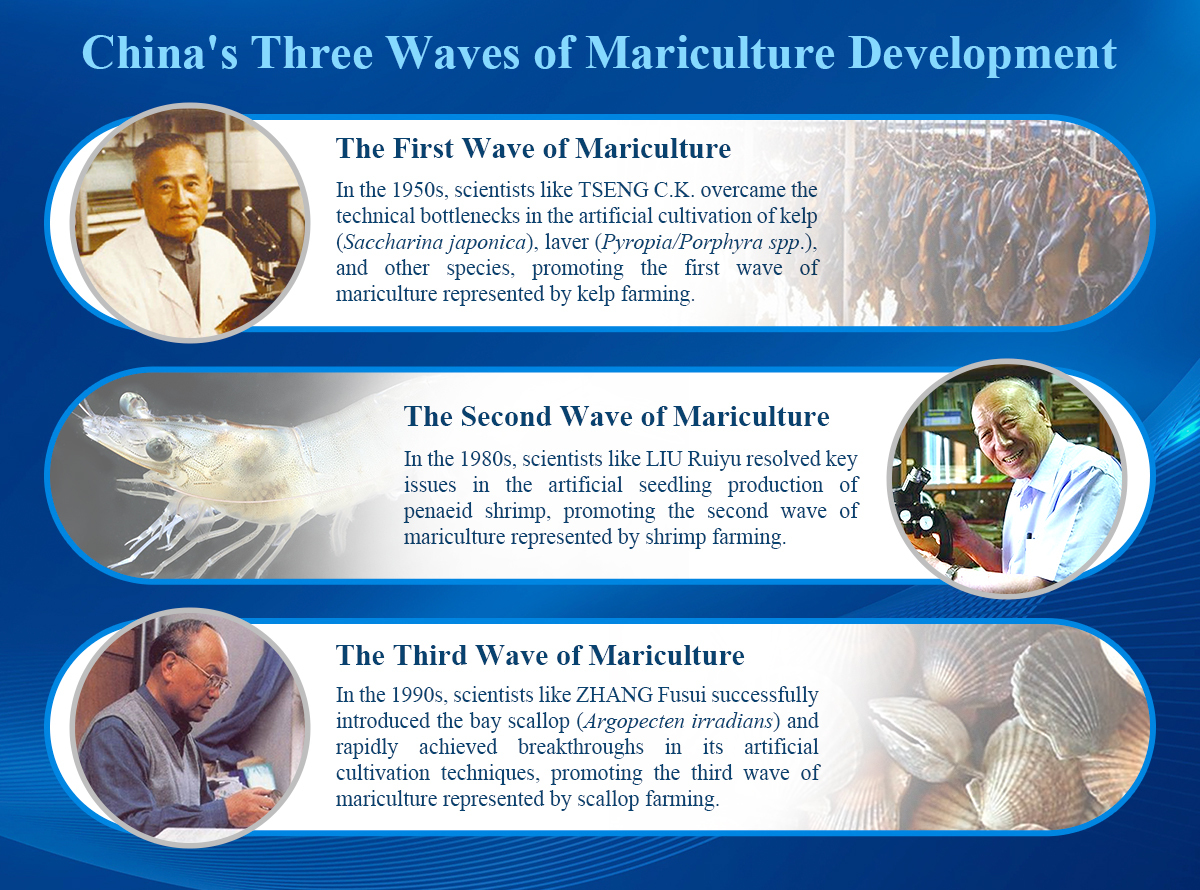
China's Three Waves of Mariculture Development. Credit: IOCAS
Contact:
Address: No. 88 Haijun Road, Qingdao, China (266000)
Tel / Fax: 86-532-82898565

